Pages

Labels

Thursday, March 24, 2016

mpreza brings new platform, tech and style to NY


One of the carmakers to pull such a feat was Subaru, which made a decision to provide a sneak preview of the 2017 Impreza to a select few a few hours before the New York International Auto Show opens its gates for the professional media representatives.

Subaru has stopped the strip tease and finally whipped the covers off its new production Impreza in NY. But it really doesn’t seem to.

The Impreza is underpinned by an all-new structure, called Global Platform, which will be used for all future Subarus, including a new WRX STi, which is tipped to be a four-wheel-drive performance hybrid. As how it is pictured above, you can see that the Imrpeza looks so ordinary, much like the Chevrolet Malibu and Toyota Camry. “The Impreza is the first sign of our new design direction”.

The new Impreza will be slightly bigger than the current model: the wheelbase will grow by 25mm, it’ll be 41mm longer and it’ll get 38mm wider. In the Sport model, active torque vectoring increases corning capability.

The 2017 Impreza will be available in four trim and equipment levels, including a new sport model.

The 5-door Impreza for 2017. The new suspension setup also has its rear stabilizer attached directly to the body, which is claimed to reduce body roll by 50 percent compared to previous models. It’s loaded up with plenty of aesthetic enhancements as well, including LED running lights, black trim, red interior stitching and Sport-specific gauges. The base will start with a 6.5-inch multimedia touchscreen with Apple CarPlay and Android Auto compatibility, with the Premium trim adding 16-inch alloy wheels and the all-weather package that will offer heated front seats and mirrors, among other items. The handsome duo carries familiar Subaru styling cues, and, as Doll told Wheels at last year’s LA motor show, aren’t far removed from the 2015 concept cars.

Pricing for the new sedan will be revealed closer to the model’s commercial launch in the fall. The available EyeSight system carries over and includes a long list of advanced safety and driver assistance features, including automatic high-beams, adaptive cruise control, pre-collision braking, lane departure warning, bling-spot monitoring, and reverse automatic braking, which applies the brakes if there’s an obstacle behind the vehicle.

Source by : http://www.tjcnewspaper.com/impreza-brings-new-platform-tech-and-style-to-ny-370481/

Four ways emerging tech is empowering women

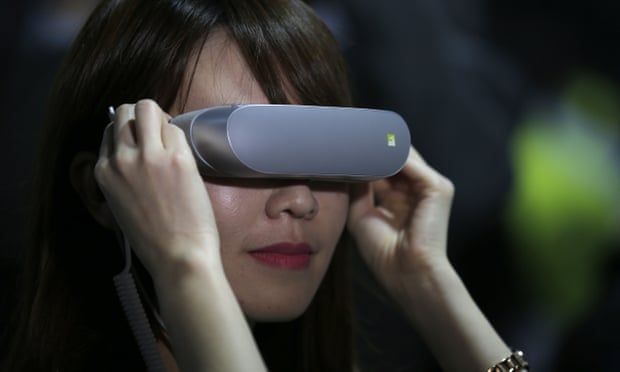
The Kiya Project uses virtual reality headsets like this to inspire empathy and raise awareness of domestic abuse. Photograph: Manu Fernandez/AP

I am so proud to be a woman working in tech. Thanks to the digital revolution women are equipped and empowered to effect change like never before.

The internet has been central to driving the fourth wave of feminism – through factors such as exchange of information, access to investment opportunities and the democratisation of data. Now other emerging technologies have the potential to have a similarly profound effect.

The likes of virtual reality and 3D printing are a long way from finding the killer app that will makes them commercially attractive, but people and organisations are already using this technology in ways that positively impact upon women’s lives.

The virtual reality empathy effect
It may not have hit the mainstream quite yet (though that could well change this year) but the potential offered by virtual reality technology is vast – both for commercial applications and those with a more social-oriented, not-for-profit purpose. For the latter, it’s all about the potential to generate empathy through immersion. What better way to promote understanding of a cause than parachuting potential supporters into the centre of it?

The award-winning VR film Clouds Over Sidra, which follows the daily routine of a young Syrian girl in a Jordanian refugee camp, was funded by the United Nations as part of a campaign to highlight the plight of vulnerable, dispossessed communities. Meanwhile The Kiya project takes the same immersive approach and applies it to domestic violence, by placing viewers in a story of a woman suffering from abuse, allowing them to see the situation through her own eyes.

The empathetic potential of VR isn’t just being utilised to raise awareness, it is being used in situational training too. Last year Torbay hospital created a virtual reality film following a patient’s journey from ambulance to operating theatre, allowing doctors to share and appreciate a patient’s experience and potentially re-assess their patient-handling approaches. It’s easy to see how a similar approach could be used with frontline workers who have to interact with vulnerable women who have experienced violence or abuse.

3D printing empowering African women
This technology boasts life-saving credentials and is even being heralded as the saviour of the high street bank. And even though we are a long way from the reality of a 3D printer nestling in a corner in every home, the technology is already starting to directly touch women’s lives. Research has found that take-up of artisanal 3D printing is more prevalent among women than men.

Coming from the more commercial end of the spectrum is the Mink device, a pen-like digital printer that can create cosmetics of any shade. It’s not going to change the world, but it’s empowering to be able to choose and create nonetheless.

At the other end of scale, there is African NGO the Youth For Technology Foundation’s 3D Africa project. Based around bringing new fabrication technologies into the classroom and wider communities, the initiative primarily targets young women. YTF’s founder, Njideka Harry, is keen to stress that it’s only not only about educating students about the intricacies of digital design but also their parents and guardians about its potential.

Taking on the Zika virus
The ease with which location-specific information can be shared – and analysed – has been one of the cornerstones of the digital age. The ability to accurately gather data, analyse it and then disseminate the findings in real time has countless applications. Also, the democratising principles of crowd-sourcing that data lends the information a trustworthiness that can be critical in the pro-social sphere.

At the start of this month, for example, Google announced a new partnership with Unicef aimed at mapping, and ultimately halting, the spread of the Zika virus among pregnant women in Latin America. The open-source platform gathers data from a range of sources, including user-generated data, to create an accurate situational awareness of the Zika virus that 10 years ago would have been denied to the organisations combating the virus and those at risk from it. It is hoped that by analysing patterns and trends, governments and NGOs could better target their resources.

Unmanned aerial vehicles
The delivery potential of drones isn’t necessarily limited to missiles and cheap books. California tech outfit Matternet has already conducted field trials based around delivering medical supplies in Haiti, while a similar distribution trial in the Dominican Republic saw drones deliver medicines from healthcare hubs into small centres in remote, inaccessible areas, and return laden with samples taken by doctors ready to be analysed in a central lab.

In Germany, meanwhile, where abortion medication is legal activists used a drone to deliver abortion pills across the border into Poland, where such medication is banned. While this second example may be more about activism than providing genuine medical utility – highlighting the way women on one side of a river have the right to choose while those on the other do not – it shows how this technology can be adapted to non-commercial purposes that help forward the women’s agenda.

Amanda McKenna is a partner at digital agency Zone.

Talk to us on Twitter via @GdnWomenLeaders and sign up to become a member of the Women in Leadership network and receive our newsletter.


More features Topics
Women  Virtual reality  Virtual worlds  Zika virus
Share on LinkedIn Share on Google+  Save for later
Reuse this content
Most popular

Radovan Karadžić sentenced to 40 years for Srebrenica genocide

Johan Cruyff, Total Football pioneer, dies at the age of 68

Adam Johnson jailed for six years for sexual activity with schoolgirl

The scariest thing about Brussels is our reaction to it | Simon Jenkins

Jian Ghomeshi acquitted of all charges in sexual

Source by : http://www.theguardian.com/women-in-leadership/2016/mar/24/four-ways-emerging-tech-is-empowering-women

Tech could help secure public spaces, if Europe wants more surveillance


LONDON/BRUSSELS (Reuters) - Facial recognition software, scanners that detect weapons and cameras that spot nervous people are some of the technologies that could be used more widely to secure public places, but some would require greater acceptance of surveillance in Europe.

The deadly attacks in Brussels on Tuesday highlighted the vulnerability of Europe's airports and transport systems.

European Union officials, grappling with the conundrum of how to increase security while retaining the openness of society, have convened meetings to discuss aviation and land transport security.

Their goal is to be able to monitor passengers unobtrusively while minimizing additional hold ups that create crowds, which can themselves become new targets.

Experts say technology cannot solve the problem on its own, but techniques such as facial recognition able to pick out known suspects can help if Europeans decide they want more surveillance.

Technology security expert and academic Pierluigi Paganini said if properly applied, facial recognition technology could have alerted security forces to the bombers at Brussels airport.

"For the technology to be effective, it is however necessary to have several cameras operating, especially, in the case of an airport, at the transit zones," he said.

Paul Murphy from IndigoVision, a British company which specializes in video security systems, said a typical system could require 2,000 cameras and powerful computer servers.

"Only in the last two years has it become affordable and reliable," he said. "The cost has been prohibitive until recently and also the technology wasn't quite good enough."

Such systems have been installed at Israel's Ben Gurion International, major hubs in the Middle East and an airport in South America, he said.

But the technology was still not as good as a human, he said, and it could be hampered by simple measures like donning headwear. At least one of the bombers in Brussels was wearing a hat.

Recognizing a suspect in real time is far harder than identifying a suspect after an incident.

"Comparing all of those faces (in a crowd) against a database is a enormously difficult task," said Kevin Riordan, UK director of checkpoint solutions at British airport scanner maker Smiths. "Looking for a particular face in a crowd is easier."

Real-time identification requires the suspect to be known to authorities and present in the database used by the airport.

Elke Oberg of German software group Cognitec said the availability of data to be matched with images taken by cameras was a problem.

"For this, it is obvious that security agencies should share more information, in compatible formats, which is rarely the case at the moment," she said.

NERVOUS FLUSH

The latest airport body scanner machines detect hidden objects with extremely high frequency radiation known as millimeter waves, which bounce off things they strike.

Britain's Qinetiq, a privatized former government defense research agency, is working on Passive Millimetre Wave technology that monitors naturally occurring energy from passengers, rather than requiring them to queue up and pass through a scanner that shines a beam at them.

It can find concealed weapons at a distance of up to 15 meters, the company says.

But any such technologies would still rely on security people on the ground able to respond in seconds.

"There are some technologies that are moving us forward, but many of them rely on people making decisions," said Chris Phillips, former head of Britain's National Counter-Terrorism Security office.

Israel's Suspect Detection Systems (SDS) is developing thermal cameras able to point out suspects in a crowd by spotting unusual body heat, signaling nervousness.

Chief Executive Shabtai Shoval, however, also said surveillance must be combined with agents on the ground.

"For example, if set up at the entrance to a terminal to mark out potential terrorists, it would be of limited use if there are not security personnel available on the spot to intercept them," he said.

One change on the table at the EU talks will be screening passengers at the entrance to airports, a process already in place in locations like Istanbul.

Smith's Riordan said technology was not good enough to scan passengers as they entered a terminal without interrupting the flow.

"Millimetre wave technology can do that to a certain range, but whether it can detect what is in somebody's rucksack is another matter."

Security portals, which passengers could walk through largely unimpeded, had been deployed, he said, but their effectiveness was limited by the explosives used in attacks not being "very smelly".

A better solution might be more use of dogs. "They're much smarter if trained correctly," one EU official said.

Another technology being developed by Israel's SDS would allow authorities to contact smartphone-holders in the vicinity of a suspected terrorist incident and commandeer the cameras on their smartphones.

    "This could be applied after there is an initial attack and a pursuit of suspects, or when an attack has not yet happened but a suspect has been reported," Shoval said.

But the technology would require a mind-set shift on the part of civilians, turning them into first-responders.

"Israelis are used to this. In Israel, civilians feel like they are also on the front line," he said. "The question is whether the same can be said for Europeans."

(Writing by Paul Sandle; additional reporting by Dan Williams, Tova Cohen, Julia Fioretti and Eric Auchard; editing by Peter Graff)

Source by : http://news.yahoo.com/tech-could-help-secure-public-spaces-europe-wants-170057132--sector.html

New Apple products on deck: What to expect


All eyes will be on Apple’s Infinite Loop campus in Cupertino, Calif. Monday as the tech giant unveils its latest products.

Much of the chatter in the weeks leading up to the event has focused on a rumored iPhone SE with a 4-inch screen, which could replace the iPhone 5s in Apple’s product lineup.

In keeping with previous launches, Apple’s online store went offline early Monday in preparation for new products. A note reading “we can’t wait to show you what we have in store,” appeared on the site. “Our virtual doors are just about to open,” it added. The event kicks off at 1 p.m. ET. Fox News' Clayton Morris is live-tweeting from the event.

Related: Apple will host 'let us loop you in' media event on March 21

“The iPhone SE is expected to possess a smaller 4 inch screen compared to the 6S and 6S Plus but will be identical in size to the 5S launched in 2013,” explained Angelo Zino, equity analyst at S&P Global Market Intelligence, in a recent note. “However, this device is seen having capabilities like Apple Pay (not available in the 5S) and an A9 processor, which is used in AAPL's most recent devices.”

Citing unnamed sources, 9to5Mac reports that the iPhone SE, like the iPhone 5s, could have a $450 starting price.

Drexel Hamilton analyst Brian White believes that the iPhone SE could prove particularly successful in markets such as China and India. “We believe a starting price point in the range of $400-$500 for the iPhone SE (bias toward the mid-point) makes sense vs. $649 for the 16GB iPhone 6s, $549 for the 16GB iPhone 6 and $450 for the 16GB iPhone 5s,” he wrote, in a recent note. “We believe Apple will now be able to better tap into consumers that are just starting to enter the middle class (mostly coming from Asia) in developing countries.”

Related: What to expect from Apple's March 21 event

Apple may also use Monday’s event as the launchpad for a 9.7-inch version of its iPad Pro, according to experts. A large iPad Pro with a 12.9-inch screen was launched last year.

The company, explained S&P Global Market Intelligence’s Zino, is projected to release a smaller 9.7-inch version of the larger iPad Pro that began shipping last fall. “We assume the device will essentially have the same capabilities as the larger iPad Pro version but utilizing a smaller screen and at a lower price point,” he wrote, in his recent note. “We believe AAPL has thus far seen limited success with its larger screen iPad Pro but note struggles across its entire iPad portfolio.”

Apple sold 16.1 million iPads during its recent fiscal first quarter, a 25 percent slump on the prior year’s quarter, as the tablet faces competition from large-screen phones or “phablets” such as the iPhone 6, iPhone 6s and Samsung’s Galaxy S6.

Related: What to expect from Apple's rumored iPhone SE

Citing unnamed sources 9to5 Mac reports that a 9.7-inch iPad Pro could have a starting price of $599 and include 32 GB of storage.

There has also been talk that Apple could unveil an iPad Air 3 during Monday’s event. The company is yet to refresh the 9.7-inch iPad Air 2 that launched in October 2014. However, Drexel Hamilton’s White thinks we’re more likely to see a 9.7-inch iPad Pro than an iPad Air 3.

Related: Apple rushing to catch up with Samsung on displays, reports say

Invites to Monday’s event feature the words ‘Let us loop you in,’ fueling speculation that Apple may be preparing a new band for its Apple Watch or even a return of the iPod loop strap.

Zino of S&P Global Market Intelligence thinks that we’re unlikely to see Apple CEO Tim Cook brandishing a next-generation Apple Watch Monday. ‘While last spring AAPL used this event to announce details of the 1st generation Apple Watch, we do not anticipate a next generation hardware device to be announced until the fall,” he wrote. “Instead, we expect AAPL to reveal new band materials/colors for the Apple Watch with the potential to reveal a software update that will likely only have modest improvements.”

Source by : http://www.foxnews.com/tech/2016/03/21/new-apple-products-on-deck-what-to-expect.html

City envy: we want New York's high-tech buses


So, after approximately 1 million years, TfL has finally announced a provisional date for the night tube. Excuse us while we spontaneously break into a sarcastic slow handclap, not least because New York's been doing the 24-hour tube thing literally since 1904. Those pioneering Statesiders have just gone and bested us when it comes to buses too, with the announcement of a fleet of new super-vehicles.

Set to roll out in April, they'll be kitted out with the two things essential to human survival: free wi-fi and USB charging ports. They'll even have fancy LCD screens to keep passengers updated on travel information, the weather and Donald Trump's latest tonsorial abomination (possibly). We've even heard rumours that these badboys will have windows that actually open. And that's a future we can all get behind.

Source by : http://www.timeout.com/london/blog/city-envy-we-want-new-yorks-high-tech-buses-032416

New technology may cut length of prostate cancer treatment

The better radiation therapy can be targeted, the less of it patients will need -- making real-time adjustment of a radiation beam during treatment a potentially significant improvement. Photo by Alexander Tihonov/Shutterstock

SYDNEY, Austria, March 23 (UPI) -- Researchers in Australia will test new technology to improve accuracy of radiation therapy for prostate cancer, potentially cutting the number of treatments a patient needs from 40 to five.

The TROG 15.01 SPARK trial will test kilovoltage intrafraction monitoring, or KIM, which images tumors while delivering treatment, allowing doctors to keep radiation beams on the tumor while also intensifying the treatment -- slashing the number of treatments needed.

The researchers are focusing on prostate cancer patients being treated with stereotactic prostate adaptive radiotherapy, but said if the trial is successful the technique could be applicable to treating other types of cancer as well.

"The KIM technology will enable safer radiation dose intensification, and therefore the SPARK trial cancer patients will be treated in five treatment sessions over two weeks," Paul Keall, a professor at the University of Sydney, said in a press release. "Potential patients are enthusiastic about the increased accuracy and the shorter treatment time. There are economic benefits to shorter treatment times also, reducing hospital workload and costs as well as the time off work and transport for patients and their families."

KIM uses previous images and images taken during a procedure to estimate a tumor's position, even a difference of a millimeter caused by a patient shifting his weight, according to previous studies. The system allows doctors to adjust a radiation beam while delivering the treatment, making it more accurate in the process.

The researchers point to several potential benefits of the new technology, including lower costs, shorter treatment periods, a reduction in hospital workload and less time patients need to dedicate to facilitating their treatment.

The current study has focused on prostate cancer but Keall said it may prove to be usable with other cancers affected by motion, including cancer of the lung, liver, kidney and pancreas.

"This Australian technology could become the global standard of care for many cancer patients," Keall said.

Source by : http://www.upi.com/Health_News/2016/03/23/New-technology-may-cut-length-of-prostate-cancer-treatment/3781458747544/

Update Patch 1.06 Now Available For PES 2016


Konami has now released update patch 1.06 for PES 2016. This new big update includes Data Pack 3.0 and also additional content for the Euro 2016 tournament.

The update patch size for PES 2016 is 3.9GB on PS4 and only 490MB on PC for some reason. It’s unknown how big the Xbox One version will be, but it’s possible it will be closer to the PS4’s file size.

In terms of the update itself, Konami’s Adam Bhatti revealed more information about it during an interview with Squawka/. He admitted that only having 15 officially licensed teams from the Euro 2016 tournament is disappointing, but gamers can find a loophole to make things more accurate. He said people can use the edit mode if they’re not satisfied.

The reason that only some teams are available is because they are owned by EA Sports’ FIFA franchise. Bhatti said Konami made the uniforms as accurate as possible without getting legal issues so that’s a bit of a plus.

The 1.06 update patch will also bring in around 200 new player faces to PES 2016. All of the new player faces are for those that will be competing in Euro 2016.

It’s worth mentioning that the Euro 2016 add-on is free for all owners of PES 2016. Just downloading the new update patch will let you experience Euro 2016 in all its glory.

Source by : http://attackofthefanboy.com/news/update-patch-1-06-now-available-pes-2016/

Sony set to make PlayStation games for iOS, Android

Sony has formed a new company that will create mobile games for iOS and Android devices using the intellectual property from its PlayStation characters and titles.

The new business called ForwardWorks Corporation will begin operation from April 1, Sony said in a release on Thursday.

"ForwardWorks will leverage the intellectual property of the numerous PlayStation dedicated software titles and its gaming characters as well as the knowledge and know-how of gaming development expertise which was acquired over the years with PlayStation business to provide gaming application optimized for smart devices including smartphones to users in Japan and Asia," the statement said.

Sony will be releasing "fully-fledged" game titles but did not give any timeline. The move is part of a push by Sony to attract more users across different platforms into its ecosystem, and therefore sell them more software and services.


The Japanese electronics giant follows rival Nintendo in trying to tap the mobile gaming market. Nintendo announced over the weekend that its first mobile app, Miitomo, racked up a million users in three days.

Mobile is seen as a key part of Nintendo's strategy and has been a big focus for the company over the past year. Nintendo struck a partnership with mobile firm DeNA last year and said together, they plan to launch five smartphone games before 2017.

Smartphone games have done well at attracting so-called "casual gamers" who may not necessarily be into console gaming. The move by both Sony and Nintendo is an attempt to capture these users.

Sony has been putting a big emphasis on its gaming division as other areas such as its smartphone unit slow. The PlayStation is also seen is a key area of growth for Sony.

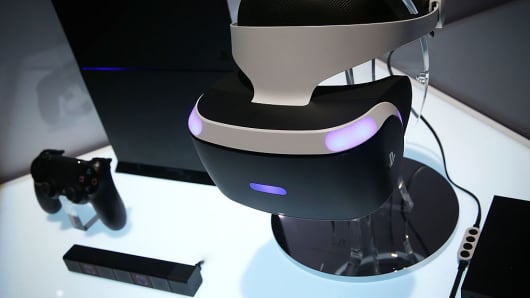
It has launched PlayStation VR – its virtual reality headset which is currently on pre-order. It also recently expanded its "Remote Play" feature to be compatible with Windows PC and Apple Mac as it looks to tap a wider audience.

On top of this, Sony offers a number of peripheral services around the PlayStation, including its membership service that allows people to play online called PlayStation Plus.

Sony has also announced that Sony Computer Entertainment (SCE) will change its name to Sony Interactive Entertainment (SIE), effective from April 1.

Source by : http://www.cnbc.com/2016/03/24/sony-set-to-make-playstation-games-for-ios-android.html

Apple announces iPhone SE: a smaller, cheaper smartphone

Revamped iPhone 5S brings company’s smallest phone up to par with 2015’s iPhone 6S, while catering for those who want a smaller phone
Key points of Apple’s iPhone SE launch at a glance
iOS 9.3: better sleep, Health app and fingerprint-locking for Notes
Apple unveils smaller iPad Pro with stylus and keyboard support


    Apple has bucked the bigger-is-better phone trend and released a revamped version of its 4in iPhone 5S, the new iPhone SE.

    It will be the smallest smartphone in Apple’s current lineup and the first smartphone to be released with a screen smaller than 4.7in since the iPhone 6 was released in September 2014.

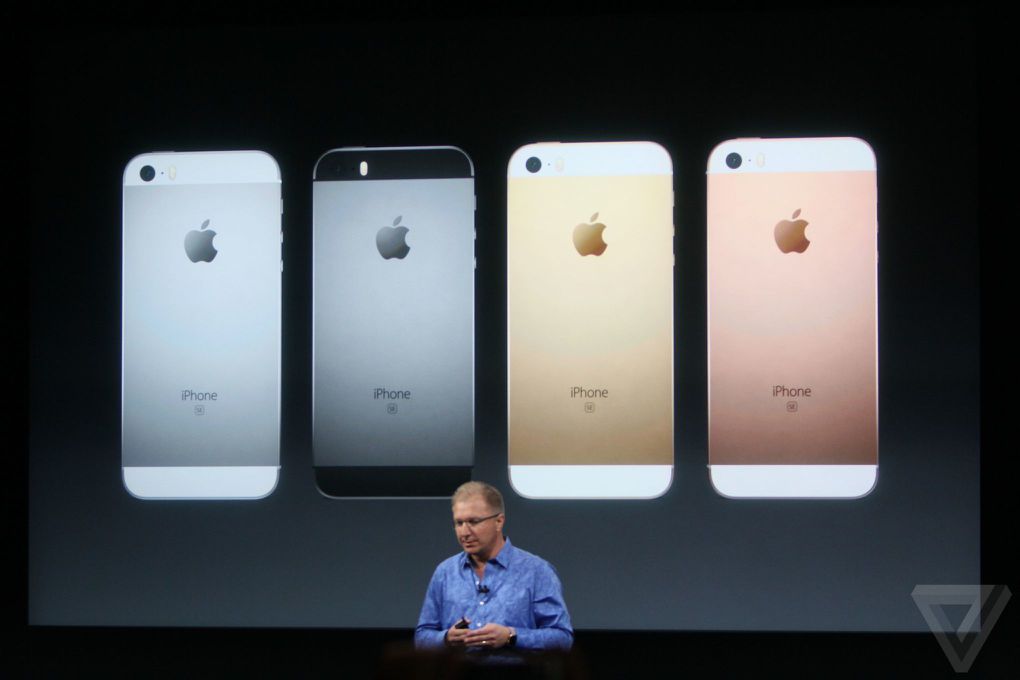
    Greg Joswiak, VP of product marketing for Apple, said: “Some people simply love smaller phones. And the 4in phone is often their first iPhone. Some people asked and pleaded with us. So we’re calling it the iPhone SE. Our most powerful 4in phone ever.”

    The iPhone SE – possibly harking back in name to the Macintosh SE computer, which was released in 1987 – has a similar form-factor to 2013’s iPhone 5S. It has a metal body, 4in screen, Touch ID fingerprint scanner and a flush camera lens, unlike Apple’s most recent iPhones. The phone will be available in black, white, gold and rose gold.

    The outside of the device resembles an iPhone 5S but the inside will be similar to the iPhone 6S, using Apple’s A9 processor, an NFC chip with support for Apple Pay and a better 12-megapixel camera, in line with Apple’s 2015 iPhones.

     The iPhone 5S, launched in 2013
     The iPhone 5S, launched in 2013. Photograph: Marcio Jose Sanchez/AP
    The iPhone SE has double the processing power and four times the graphics performance of the iPhone 5S, as well as longer battery life.

    Apple hopes that the smaller smartphone will convince those still using an iPhone 5, 5S or 5C, but who do not want a larger phone of the size of the 4.7in iPhone 6S or 5.5in 6S Plus, to upgrade. Cook estimates that 60% of those using Apple’s smaller iPhones have not yet upgraded to an iPhone 6 or newer, meaning there is a large potential market waiting to be tapped.

    Larger smartphone screens have proved popular and have allowed manufacturers to add more features supported by larger batteries, Apple’s iPhone with its 4.7in screen is remained one of the smallest.

    As a smaller, premium smartphone, the new iPhone SE has little in the way of competition. Only Sony produces a widely available flagship smartphone with a smaller screen, with the 4.6in Xperia Z5 Compact. Other smaller phones made by Motorola, HTC and Samsung are cut-down, cheaper versions with poorer components that target a more budget-conscious section of the market.

    Advertisement

    Whether there is still demand for a smaller premium-priced smartphone remains to be seen. The downward pressure on price has meant decent smartphones now cost as little as £130, with features similar to top-end models costing four times their price.

    For Apple, the iPhone SE represents a way to target a more cost-sensitive market without stooping to budget levels. In the past the company has used older models of the iPhone, maintaining the 2012 iPhone 4S for sale until the release of the iPhone 6 in 2014, and previous models before that. But selling older smartphones concurrently with new models has added to the company’s burden to maintain smartphone updates for longer, which it typically does for at least three years after release.

    The iPhone SE, with internals similar to an iPhone 6S but at a lower price, is easier to cater for with software updates because it reduces the number of hardware variants Apple has to support.

    The iPhone SE will be released on 31 March, with pre-orders starting 24 March, costing from $399 in the US, or £359 in the UK, for 16GB of storage; $499 in the US, or £439 in the UK, with 64GB of storage.

    Source by : http://www.theguardian.com/technology/2016/mar/21/iphone-se-4in-apple-smartphone-launched-cheaper-price

    Sony Xperia Z5 review: good but not exceptional

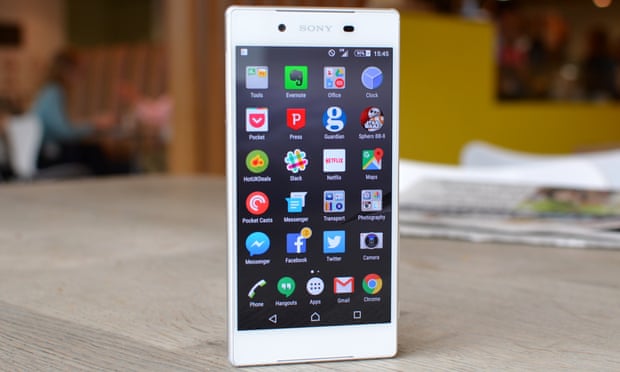
     The Sony Xperia Z5 is the latest flagship smartphone with a fingerprint reader hidden under the power button on the side. Photograph: Samuel Gibbs for the Guardian
    The latest smartphone from Sony has the fastest camera available on a smartphone and promises a two-day battery, but does it deliver?

    After the high of the Xperia Z3 and its great battery life, Sony’s follow-up the Z3+ suffered badly from overheating issues. Skipping the number four, the Xperia Z5 has a lot to prove.

    This review was conducted using a near-final prototype. Although unlikely, some aspects may be different to the device that goes on sale.

    Minimalist design

     Sony’s simple, minimalist design will be familiar to anyone who has looked at any of the company’s other phones from the last three years. Photograph: Samuel Gibbs for the Guardian

    To say Sony is iterative on design would be an understatement. The Z5 looks just like the various Sony flagships from the last two or three years.

    Advertisement

    All glass, back and front, held together by a band of metal with plastic corners that are meant to absorb the energy of a drop to the floor and help the screen not shatter.

    The frosted glass back both looks and feels nice, while the phone is reassuringly solid in the hand. The device is waterproof, so trips into the pond won’t matter too much, but the USB port and headphones port are both exposed so there’s no need to mess with fiddly doors. Wireless charging, which you would think would be perfect for something like this, is disappointedly absent.

    The 5.2in LCD display is great. Vibrant, colourful, bright and with good viewing angles. It isn’t quite as eye-popping as some rival OLED screens from Samsung or as pixel perfect as higher resolution LG’s 2K LCD, but most will be more than satisfied with the screen.

    The phone is slightly thicker than high-end rivals from Apple and Samsung at 7.3mm thick, but is easy to slip into a pocket or to hold, particularly compared to larger phablets with screens over 5.5in.

    The front-facing speakers are decent, for small phone speakers, and make it easier to watch videos in stereo without blocking the speaker with your hands.

     The Xperia Z5 is relatively easy to hold for a smartphone with a screen larger than 5in. Photograph: Samuel Gibbs for the Guardian
    Specifications
    Screen: 5.2in 1080p LCD (424ppi)
    Processor: octa-core Qualcomm Snapdragon 810
    RAM: 3GB of RAM
    Storage: 32GB; microSD card slot
    Operating system: Android 5.1.1 “Lollipop”
    Camera: 23MP rear camera, 5MP front-facing camera
    Connectivity: LTE, Wi-Fi, NFC, Bluetooth 4 and GPS
    Dimensions: 146 x 72 x 7.3 mm
    Weight: 154g

    Not quite as hot
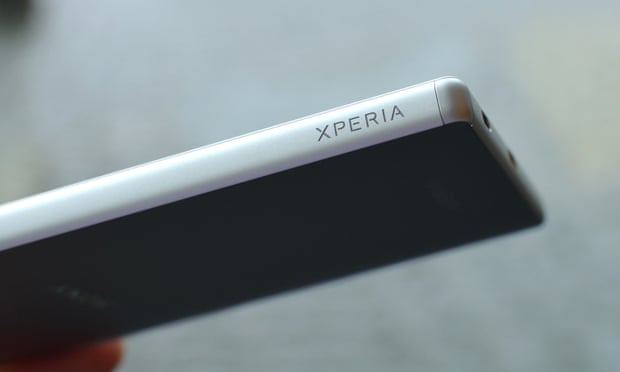
    The Xperia logo is etched into the metal sides. Photograph: Samuel Gibbs for the Guardian

    The Xperia Z5 contains Qualcomm’s Snapdragon 810, which has been responsible for causing overheating issues in not only Sony’s previous Z3+ but in other Android flagship devices.

    Advertisement

    The Z5 does get warm, but not enough to cause issues in my testing. It was warmest when downloading music for offline playback, not when playing a graphically intensive game.

    The phone doesn’t seem to suffer from slow down when it gets hot and while it isn’t the fastest smartphone available – that would be the Samsung Galaxy S6 – the Xperia Z5 performs well. It doesn’t quite have the same zip as some other top-end Android smartphones.

    I found battery life a little disappointing. Without using any of Sony’s battery saving modes the Xperia Z5 only lasted an average of 34 hours 30 minutes between charges, using it as a primary device with hundreds of push emails, notifications three hours of browsing and two hours of listening to music via Bluetooth headphones per day.

    Compared to the day’s battery most smartphones provide, over 34 hours is good, but it’s a far cry from the up to two-days battery Sony is claiming. It’s possible battery life may get better in production models.

    Sony’s Stamina mode, which provides a whitelist of apps while disabling others when the screen is off, works well and brings the battery life closer to 48 hours in my testing.

    I noticed that the camera impacted the battery life considerably, running the battery almost flat in under 18 hours shooting around 40 photos at a wedding.

    Sony customises the standard Android 5.1 Lollipop experience with small modifications. The version installed on the Xperia Z5 is Sony’s lightest touch yet, and while it looks a little aesthetically different it will be familiar to anyone who has used Android in the past.

    Sony makes some useful additions, including more customisable quick settings toggles in the notifications shade, some task automation, such as turning on the Wi-Fi when you get home, and theme support to change the look of the software.

    Most of Sony’s apps, including the Music app work well enough, but can be ignored if you already use alternatives including Google’s or something like Spotify.

    Camera
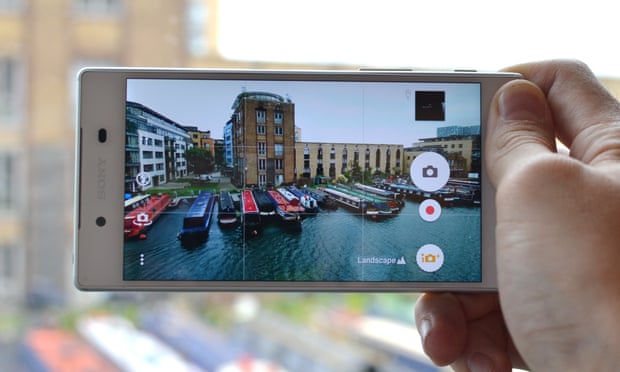
    The camera app is one of the best on the market with plenty of features. Photograph: Samuel Gibbs for the Guardian

    The Z5 has Sony’s first new camera sensor in two years and increases the resolution to 23-megapixels from the 21 available on previous smartphones.

    Advertisement

    The megapixel count allows the phone to produce 8-megapixel images with a 5-times digital zoom without losing detail, or oversample without zooming, which helps to remove noise and artefacts.

    Sony’s camera app is excellent with great automatic modes and enough manual settings to keep most happy. Photos look great, with good detail and colour accuracy in middling and good light. Low light performance is OK, but not best in class. Focusing was very fast, but sometimes struggled in lowlight situations. I found the flash was particularly ineffective.

    The front-facing camera produces acceptable, if not spectacular, selfies – often looking a bit soft. This is flattering for most people, but diminishes detail in the photo.

    Video recorded using Sony’s Steadyshot is smooth, removing camera shake and the jarring motion of bad dancing. The camera can record 4K video and doesn’t overheat, but at 300MB per minute you will need a large SD card for capturing anything in length

    Fingerprint scanner

     The fingerprint sensor under the power button is excellent. Photograph: Samuel Gibbs for the Guardian

    Sony has fitted a fingerprint scanner under the power button on the side of the device, which is excellent. It isn’t as fast as Huawei’s sensor, but it recognised my thumb 99% of the time without issue, and has yet to fail to recognise my left index finger.

    Having it under the power button on the side is the most convenient place I have come across for fingerprint sensor placement, and means there’s no risk of dropping the device.

    Price
    The Sony Xperia Z5 is available for pre-order in black, white, gold and green, costing £550, which makes it similarly priced to Samsung Galaxy S6 and slightly cheaper than Apple’s iPhone 6S.

    Verdict
    The Xperia Z5 is a great flagship smartphone, and arguably the best Sony smartphone yet. The slightly more squared-off design compared to the Z3 makes it look a little more generic, but the frosted glass on the back is considerably more attractive.

    The best parts about the Z5 are the fingerprint sensor and the camera, but competitors including Apple and Samsung have equally good systems.

    It’s difficult to stand out in the crowded high-end smartphone market, and not quite making two-days of battery is disappointing. The Z5 is good, it’s just not quite the best.

    Pros: waterproof, good camera, microSD card slot, great fingerprint scanner

    Cons: doesn’t live up to battery expectations, no wireless charging, not the snappiest, weak camera flash, can get quite warm

    Source by : http://www.theguardian.com/technology/2015/sep/19/sony-xperia-z5-review-waterproof-fingerprint-scanner

    Monday, March 21, 2016

    SOLAR SOLUTION MAY MAKE NUCLEAR WASTE STORAGE SAFER


    By adapting a technology originally developed for solar energy, scientists have figured out how to selectively remove one of the trickiest and most-difficult-to-remove elements in nuclear waste pools. The advance makes the storage of nuclear waste safer and nontoxic—and solves a decades-old problem.

    The work, published in Science, not only opens the door to expand the use of one of the most efficient energy sources on the planet, but also adds a key step in completing the nuclear fuel cycle—an advance that, along with wind and solar, could help cleanly power the world’s future energy needs.

    “In order to solve the nuclear waste problem, you have to solve the americium problem,” says Tom Meyer, professor of chemistry at the University of North Carolina at Chapel Hill.

    Americium doesn’t have the same name recognition as a plutonium and uranium, but researchers have been trying to remove it from nuclear waste for decades. Several groups initially succeeded, only to be met with several subsequent problems down the line, rendering the solution unfeasible.

    [IS THE U.S. BURYING TOO MUCH PLUTONIUM IN NEW MEXICO?]

    But, researchers have now found a way to remove the radioactive element without encountering downstream problems that have hindered progress.

    The technology is closely related to the one used at the UNC Energy Frontier Research Center of Solar Fuels to tear electrons from water molecules. In the americium project, researchers adapted the technology to tear electrons from americium, which requires twice as much energy input as splitting water. By removing those three electrons, americium behaves like plutonium and uranium, which is then easy to remove with existing technology.

    Nuclear fuel is initially used as small solid pellets loaded into long, thin rods, says Chris Dares. To reprocess them, the used fuel is first dissolved in acid and the plutonium and uranium separated. In the process, americium will either be separated with plutonium and uranium or removed in a second step.

    The researchers worked closely with Idaho National Laboratory (INL), which provided support and technical guidance on working with nuclear materials. Most of the experiments were carried out in the laboratories at Idaho, which provided a safe area to work with radioactive material. At present, INL and UNC-Chapel Hill are in discussion about extending the research and to possible scale up of the technology.

    “With INL working with us, we have a strong foundation for scaling up this technology,” Dares says. “With a scaled up solution, not only will we no longer have to think about the dangers of storing radioactive waste long-term, but we will have a viable solution to close the nuclear fuel cycle and contribute to solving the world’s energy needs. That

    Source by  : http://www.futurity.org/americum-nuclear-waste-1121852-2/

    New Observations Show Unexpected Changes of Bright Spots on Ceres

    This artist’s impression is based on a detailed map of the surface compiled from images taken from NASA’s Dawn spacecraft in orbit around the dwarf planet Ceres. It shows the very bright patches of material in the crater Occator and elsewhere


    New observations of the bright spots on Ceres reveal daily changes on these spots, suggesting that they change under the influence of sunlight as Ceres rotates.

    Observations made using the HARPS spectrograph at ESO’s La Silla Observatory in Chile have revealed unexpected changes in the bright spots on the dwarf planet Ceres. Although Ceres appears as little more than a point of light from the Earth, very careful study of its light shows not only the changes expected as Ceres rotates, but also that the spots brighten during the day and also show other variations. These observations suggest that the material of the spots is volatile and evaporates in the warm glow of sunlight.

    Ceres is the largest body in the asteroid belt between Mars and Jupiter and the only such object classed as a dwarf planet. NASA’s Dawn spacecraft has been in orbit around Ceres for more than a year and has mapped its surface in great detail. One of the biggest surprises has been the discovery of very bright spots, which reflect far more light than their much darker surroundings. The most prominent of these spots lie inside the crater Occator and suggest that Ceres may be a much more active world than most of its asteroid neighbors.

    The new and very precise observations using the HARPS spectrograph at the ESO 3.6-metre telescope at La Silla, Chile, have not only detected the motion of the spots due to the rotation of Ceres about its axis, but also found unexpected additional variations suggesting that the material of the spots is volatile and evaporates in sunlight.

    The lead author of the new study, Paolo Molaro, at the INAF–Trieste Astronomical Observatory, takes up the story: “As soon as the Dawn spacecraft revealed the mysterious bright spots on the surface of Ceres, I immediately thought of the possible measurable effects from Earth. As Ceres rotates the spots approach the Earth and then recede again, which affects the spectrum of the reflected sunlight arriving at Earth.”

    This image taken from NASA’s Dawn spacecraft in orbit around the dwarf planet Ceres shows the very bright patches of material in the crater Occator and elsewhere

    Ceres spins every nine hours and calculations showed that the effects due to the motion of the spots towards and away from the Earth caused by this rotation would be very small, of order 20 kilometers per hour. But this motion is big enough to be measurable via the Doppler effect with high-precision instruments such as HARPS.

    The team observed Ceres with HARPS for a little over two nights in July and August 2015. “The result was a surprise,” adds Antonino Lanza, at the INAF–Catania Astrophysical Observatory and co-author of the study. “We did find the expected changes to the spectrum from the rotation of Ceres, but with considerable other variations from night to night.”

    The team concluded that the observed changes could be due to the presence of volatile substances that evaporate under the action of solar radiation. When the spots inside the Occator crater are on the side illuminated by the Sun they form plumes that reflect sunlight very effectively. These plumes then evaporate quickly, lose reflectivity and produce the observed changes. This effect, however, changes from night to night, giving rise to additional random patterns, on both short and longer timescales.

    If this interpretation is confirmed Ceres would seem to be very different from Vesta and the other main belt asteroids. Despite being relatively isolated, it seems to be internally active. Ceres is known to be rich in water, but it is unclear whether this is related to the bright spots. The energy source that drives this continual leakage of material from the surface is also unknown.

    Dawn is continuing to study Ceres and the behavior of its mysterious spots. Observations from the ground with HARPS and other facilities will be able to continue even after the end of the space mission.

    Source by : http://scitechdaily.com/new-observations-show-unexpected-changes-of-bright-spots-on-ceres/

    Hubble Space Telescope Reveals Monster Stars in Star Cluster R136

    This Hubble image shows the central region of the Tarantula Nebula in the Large Magellanic Cloud. The young and dense star cluster R136 can be seen at the lower right of the image. This cluster contains hundreds of young blue stars, among them the most massive star detected in the universe so far.
    Using the unique ultraviolet capabilities of the NASA/ESA Hubble Space Telescope, a team of astronomers has identified nine monster stars with masses over 100 times the mass of the sun in the star cluster R136. This makes it the largest sample of very massive stars identified to date.

    The results, which will be published in the monthly notices of the Royal Astronomical Society, raise many new questions about the formation of massive stars.

    An international team of scientists using the NASA/ESA Hubble Space Telescope has combined images taken with the Wide Field Camera 3 (WFC3) with the unprecedented ultraviolet spatial resolution of the Space Telescope Imaging Spectrograph (STIS) to successfully dissect the young star cluster R136 in ultraviolet light for the first time.

    R136 is only a few light-years across and is located in the Tarantula Nebula within the Large Magellanic Cloud, about 170,000 light-years away. The young cluster hosts many extremely massive, hot and luminous stars whose energy is mostly radiated in the ultraviolet range of its light spectrum. This is why the scientists probed the ultraviolet emission of the cluster.

    As well as finding dozens of stars exceeding 50 solar masses, this new study was able to reveal a total number of nine very massive stars in the cluster, all more than 100 times more massive than the sun. However, the current record holder R136a1 does keep its place as the most massive star known in the universe, at more than 250 solar masses. The detected stars are not only extremely massive, but also extremely bright. Together these nine stars outshine the sun by a factor of 30 million.

    The scientists were also able to investigate outflows from these behemoths, which are most readily studied in the ultraviolet. They eject up to an Earth mass of material per month at a speed approaching one percent of the speed of light, resulting in extreme weight loss throughout their brief lives.

    “The ability to distinguish ultraviolet light from such an exceptionally crowded region into its component parts, resolving the signatures of individual stars, was only made possible with the instruments aboard Hubble,” explains Paul Crowther from the University of Sheffield, U.K., and lead author of the study. “Together with my colleagues, I would like to acknowledge the invaluable work done by astronauts during Hubble’s last servicing mission: they restored STIS and put their own lives at risk for the sake of future science!”

    In 2010 Crowther and his collaborators showed the existence of four stars within R136, each with over 150 times the mass of the sun. At that time the extreme properties of these stars came as a surprise as they exceeded the upper-mass limit for stars that was generally accepted at that time. Now, this new census has shown that there are five more stars with more than 100 solar masses in R136. The results gathered from R136 and from other clusters also raise many new questions about the formation of massive stars as the origin of these behemoths remains unclear.

    Saida Caballero-Nieves, a co-author of the study, explains, “There have been suggestions that these monsters result from the merger of less extreme stars in close binary systems. From what we know about the frequency of massive mergers, this scenario can’t account for all the really massive stars that we see in R136, so it would appear that such stars can originate from the star formation process.”

    In order to find answers about the origin of these stars the team will continue to analyze the gathered datasets. An analysis of new optical STIS observations from Hubble will also allow them to search for close binary systems in R136. Since very massive stars burn out relatively quickly and can become black holes when they die, such binary pairs could produce massive black hole binaries that would ultimately merge, producing gravitational waves.

    “Once again, our work demonstrates that, despite being in orbit for over 25 years, there are some areas of science for which Hubble is still uniquely capable,” concludes Crowther.

    Source by : http://scitechdaily.com/hubble-space-telescope-reveals-monster-stars-in-star-cluster-r136/

    Scientists Discover Colossal ‘Super Spiral’ Galaxies

    Three examples of super spirals are presented here in images taken by the Sloan Digital Sky Survey. The super spiral on the left, cataloged as 2MASX J08542169+0449308, contains two galactic nuclei, instead of just the usual one, and thus looks like two eggs frying in a pan. The central image shows a super spiral designated 2MASX J16014061+2718161, and it also contains the double nuclei. On the right, a huge galaxy with the moniker SDSS J094700.08+254045.7 stands as one of the biggest and brightest super spirals. The mega-galaxy’s starry disk and spiral arms stretch about 320,000 light-years across, or more than three times the breadth of the Milky Way


    Using archived NASA data, researchers have discovered “super spiral” galaxies that dwarf the Milky Way and compete in size and brightness with the largest galaxies in the universe. The unprecedented galaxies have long hidden in plain sight by mimicking the appearance of typical spirals.

    A strange new kind of galactic beast has been spotted in the cosmic wilderness. Dubbed “super spirals,” these unprecedented galaxies dwarf our own spiral galaxy, the Milky Way, and compete in size and brightness with the largest galaxies in the universe.

    Super spirals have long hidden in plain sight by mimicking the appearance of typical spiral galaxies. A new study using archived NASA data reveals these seemingly nearby objects are in fact distant, behemoth versions of everyday spirals. Rare, super spiral galaxies present researchers with the major mystery of how such giants could have arisen.

    “We have found a previously unrecognized class of spiral galaxies that are as luminous and massive as the biggest, brightest galaxies we know of,” said Patrick Ogle, an astrophysicist at the Infrared Processing and Analysis Center (IPAC) at the California Institute of Technology in Pasadena and lead author of a new paper on the findings published in The Astrophysical Journal. “It’s as if we have just discovered a new land animal stomping around that is the size of an elephant but had shockingly gone unnoticed by zoologists.”

    Ogle and colleagues chanced upon super spirals as they searched for extremely luminous, massive galaxies in the NASA/IPAC Extragalactic Database (NED), an online repository containing information on over 100 million galaxies. NED brings together a wealth of data from many different projects, including ultraviolet light observations from the Galaxy Evolution Explorer, visible light from Sloan Digital Sky Survey, infrared light from the Two Micron All-Sky Survey, and links to data from other missions such as Spitzer and the Wide-field Infrared Survey Explorer, or WISE.

    “Remarkably, the finding of super spiral galaxies came out of purely analyzing the contents of the NASA/IPAC Extragalactic Database, thus reaping the benefits of the careful, systematic merging of data from many sources on the same galaxies,” said George Helou, a study co-author and the executive director of IPAC. “NED is surely holding many more such nuggets of information, and it is up to us scientists to ask the right questions to bring them out.”

    Ogle, Helou and their colleagues expected that humongous, mature galaxies called ellipticals — so named for their football-like shapes — would dominate their search within NED for the most luminous galaxies. But a tremendous surprise lay in store for the scientists.

    In a sample of approximately 800,000 galaxies no more than 3.5 billion light-years from Earth, 53 of the brightest galaxies intriguingly had a spiral, rather than elliptical, shape. The researchers double-checked the distances to the spiral galaxies and saw that none were nearby — even the closest lay some 1.2 billion light-years away. With the correct distance estimates in hand, the stunning properties of this newfound batch of whirlpool-shaped galaxies came to light.

    Super spirals can shine with anywhere from eight to 14 times the brightness of the Milky Way. They possess as much as 10 times our galaxy’s mass. Their gleaming, starry disks stretch from twice to even four times the width of the Milky Way galaxy’s approximately 100,000 light-year-wide disk, with the largest super spiral spanning a whopping 440,000 light-years. Super spirals also give off copious ultraviolet and mid-infrared light, signifying a breakneck pace of churning out new stars. Their star formation rate is as high as 30 times that of our own run-of-the-mill galaxy.

    According to established astrophysical theory, spiral galaxies should not be able to attain any of these feats because their size and star-making potential are limited. As spiral galaxies grow by gravitationally attracting fresh, cool gas from intergalactic space, their masses reach a tipping point in which any newly captured gas rushes in too rapidly. This headlong gas heats up and prevents subsequent star formation in a process known as “quenching.” Bucking this conventional wisdom, though, super spirals remain unquenched.

    A vital hint about the potential origin of super spirals is that four out of the 53 seen by Ogle and colleagues clearly contain two galactic nuclei, instead of just one as usual. Double nuclei, which look like two egg yolks frying in a pan, are a telltale sign of two galaxies having just merged together. Conventionally, mergers of spiral galaxies are destined to become bloated, elliptical galaxies. Yet Ogle and colleagues speculate that a special merger involving two, gas-rich spiral galaxies could see their pooled gases settle down into a new, larger stellar disk — presto, a super spiral.

    “Super spirals could fundamentally change our understanding of the formation and evolution of the most massive galaxies,” said Ogle. “We have much to learn from these newly identified, galactic leviathans.”

    Other authors of the new study are Lauranne Lanz of IPAC and Cyril Nader, an undergraduate student at the University of California, Los Angeles, who worked on this project during a summer internship at IPAC.

    Source by : http://scitechdaily.com/scientists-discover-colossal-super-spiral-galaxies/

    Astronomers Show Magnetic Field is Critical for Life


    n this artist’s illustration, the young Sun-like star Kappa Ceti is blotched with large starspots, a sign of its high level of magnetic activity. The physical sizes of the star and planet and distance between them are not to scale. Credit: M. Weiss/CfA
    Newly published research from the Harvard-Smithsonian Center for Astrophysics shows that any Earth-like planet would need a magnetic field in order to protect its atmosphere and be habitable.

    Nearly four billion years ago, life arose on Earth. Life appeared because our planet had a rocky surface, liquid water, and a blanketing atmosphere. But life thrived thanks to another necessary ingredient: the presence of a protective magnetic field. A new study of the young, Sun-like star Kappa Ceti shows that a magnetic field plays a key role in making a planet conducive to life.

    “To be habitable, a planet needs warmth, water, and it needs to be sheltered from a young, violent Sun,” says lead author Jose-Dias Do Nascimento of the Harvard-Smithsonian Center for Astrophysics (CfA) and University of Rio G. do Norte (UFRN), Brazil.

    Kappa Ceti, located 30 light-years away in the constellation Cetus, the Whale, is remarkably similar to our Sun but younger. The team calculates an age of only 400-600 million years old, which agrees with the age estimated from its rotation period (a technique pioneered by CfA astronomer Soren Meibom). This age roughly corresponds to the time when life first appeared on Earth. As a result, studying Kappa Ceti can give us insights into the early history of our solar system.

    Like other stars its age, Kappa Ceti is very magnetically active. Its surface is blotched with many giant starspots, like sunspots but larger and more numerous. It also propels a steady stream of plasma, or ionized gases, out into space. The research team found that this stellar wind is 50 times stronger than our Sun’s solar wind.

    Such a fierce stellar wind would batter the atmosphere of any planet in the habitable zone, unless that planet was shielded by a magnetic field. At the extreme, a planet without a magnetic field could lose most of its atmosphere. In our solar system, the planet Mars suffered this fate and turned from a world warm enough for briny oceans to a cold, dry desert.

    The team modeled the strong stellar wind of Kappa Ceti and its effect on a young Earth. The early Earth’s magnetic field is expected to have been about as strong as it is today, or slightly weaker. Depending on the assumed strength, the researchers found that the resulting protected region, or magnetosphere, of Earth would be about one-third to one-half as large as it is today.

    “The early Earth didn’t have as much protection as it does now, but it had enough,” says Do Nascimento.

    Kappa Ceti also shows evidence of “superflares” — enormous eruptions that release 10 to 100 million times more energy than the largest flares ever observed on our Sun. Flares that energetic can strip a planet’s atmosphere. By studying Kappa Ceti, researchers hope to learn how frequently it produces superflares, and therefore how often our Sun might have erupted in its youth.

    This research has been accepted for publication in The Astrophysical Journal Letters and is available online. This set of Kappa Ceti observations were part of the Bernard Lyot Telescope’s Bcool Large Program.

    Source by : http://scitechdaily.com/astronomers-show-magnetic-field-is-critical-for-life/

    King Tut's burial tomb scan shows hidden rooms, Egypt says

    The gold mask of King Tutankhamun is seen in its glass case during a 2015 press tour, in the Egyptian Museum near Tahrir Square in Cairo. Scans of King Tut's burial chamber have revealed two hidden rooms. (Hassan Ammar /Associated Press
    Scans of King Tut's burial chamber have revealed two hidden rooms, Egypt's antiquities minister said Thursday — a discovery that could intensify speculation that the chambers contain the remains of the famed Queen Nefertiti.

    Mamdouh el-Damaty told reporters that the secret chambers may contain metal or organic material, but he declined to comment on whether royal treasure or mummies could be inside. Analysis of the scans made by a Japanese team showed chambers that would be scanned again at the end of the month to get a better idea of what may lay inside, he said.

    "It means a rediscovery of Tutankhamun ... for Egypt it is a very big discovery, it could be the discovery of the century," el-Damaty said. "It is very important for Egyptian history and for all of the world."

    King Tut's tomb: Researchers now 90% sure it contains hidden chambers
    King Tut's mysterious death finally solved, film says
    The discovery could shine new light on one of ancient Egypt's most turbulent times, and one prominent researcher has theorized that the Nefertiti's remains could be inside. British Egyptologist Nicholas Reeves speculates that Tutankhamun, who died at the age of 19, may have been rushed into an outer chamber of what was originally Nefertiti's tomb, which archaeologists have yet to find.

    Famed for her beauty, Nefertiti was the subject of a famous 3,300-year-old bust. Nefertiti was one of the wives of Tutankhamun's father, the Pharaoh Akhenaten.

    Could be tomb of family member

    El-Damaty said it was too early to tell what the metal and organic material could be, saying only that he thinks the new chambers could contain the tomb of a member of Tutankhamun's family.

    The tomb lies in Luxor, in southern Egypt, which served as the Pharaonic capital in ancient times, and is home to sprawling temples and several highly decorated ancient tombs in the Valley of the Kings. The discovery of King Tut's nearly-intact tomb by Howard Carter in 1922 sparked a renewed interest in Egyptology and yielded unprecedented Pharaonic treasures, including the boy king's sarcophagus and iconic golden burial mask.

    Reeves reached his theory after high-resolution images discovered what he said were straight lines in King Tut's tomb. These lines, previously hidden by colour and the stones' texture, indicate the presence of a sealed chamber, he said. The images were broadcast live on national television last September.
    Radar scans displayed at a news conference in Cairo Thursday show anomalies in the walls of the tomb, indicating a possible hidden door and the chambers, which lay behind walls that were covered up and painted over with hieroglyphics. (Amr Nabil/Associated Press)

    At the Cairo news conference, el-Damaty highlighted radar scans that showed anomalies in the walls of the tomb, indicating a possible hidden door and the chambers, which lay behind walls that were covered up and painted over with hieroglyphics.

    Nefertiti was the primary wife of the Pharaoh Akhenaten, who unsuccessfully attempted to switch Egypt to an early form of monotheism. Akhenaten was succeeded by a pharaoh referred to as Smenkhare and then Tut, who was proven by genetic testing to have been Akhenaten's son.

    Tut, Nefertiti, and Akhenaten's family ruled Egypt during one of its most turbulent times, which ended with a military takeover by Egypt's top general at the time, Horemheb. The family's names were later erased from official records.

    Source by : http://www.cbc.ca/news/technology/king-tut-tomb-scan-hidden-rooms-1.3495230

    MIT Chemists Create New Adaptable Metallic-Cage Gels

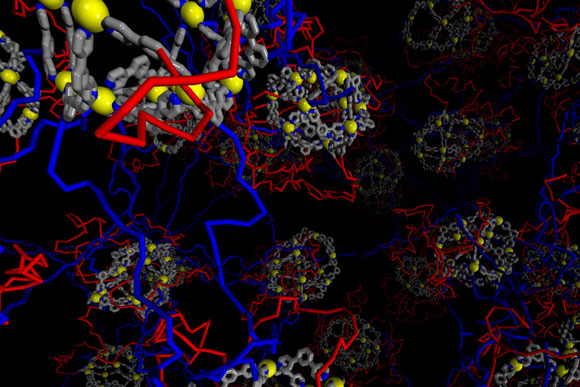
    MIT chemists have created a new type of gel by linking metal organic cages with long polymer strands (blue). The red polymer strands, which loop back to the cages, can be used to further customize the gels by adding other molecules

    By combining the flexibility of polymer gels with the rigid structure provided by metal-based clusters, chemists from MIT have created a new material that could be well-suited for a range of possible functions, including drug release, gas storage, or water filtration.

    These new gels, known as polyMOCs, are a hybrid of two materials called metallogels and metal organic cages. Metallogels, which consist of metals bound to polymer chains, are similar to regular polymer gels in that they are soft and viscoelastic. Metal organic cages (MOCs), on the other hand, have a rigid structure and tend to form crystalline materials.

    “One can imagine a class of materials that borrows from both of those, and so has the well-defined, self-assembled structures of the MOCs, but also has the viscoelastic properties of a polymer gel. That’s what we’ve tried to make,” says Jeremiah Johnson, the Roger and Georges Firmenich Assistant Professor of Natural Product Chemistry and the senior author of a paper describing the gels in Nature Chemistry.

    The paper’s lead author is Aleksandr Zhukhovitskiy, a graduate student in MIT’s Department of Chemistry.

    Self-assembly

    To create these gels, Johnson and colleagues built on a technique known as metallo-supramolecular assembly. This strategy allows chemists to generate three-dimensional shapes, such as spheres, paddlewheels, or pyramids, by mixing polymers that are attached to molecules called ligands. These ligands are organic compounds that can bind to a metal atom.

    In this case, the researchers used a ligand containing two pyridine groups that each can bind to the metal palladium. Each atom of palladium can form bonds with four other ligand molecules, creating a rigid, cage-like structure with 12 palladium centers and 24 ligands. These centers then connect with other metallic cages by flexible polymer linkers, forming a large, self-assembled gel.

    While each metal cage can have up to 24 polymer chains attached to it, only four or five of those connect to other metal cages. These extra, unattached chains loop back and attach to their own metal cage. These loops are commonly referred to as “defects,” but the MIT team saw them as an opportunity to enhance the material by replacing some of the ligands on those chains with new functional molecules.

    “We can take the ligands that aren’t connected to another cage and swap those out, while keeping the same net number of chains connecting junctions,” Johnson says. “This allows us to make completely different materials in terms of their composition, but they can have the same mechanical properties.”

    “By using these clusters of metallic organic cages, they’ve been able to increase the functionality, and this gives the materials very different properties and mechanical behavior,” says Stuart Rowan, a professor of macromolecular science and engineering at Case Western Reserve University who was not involved in the work. “It’s very elegant, fundamental science that opens the door to a whole range of directions.”

    In this study, the researchers added a fluorescent molecule called pyrene in place of some of the looped ligands. “When we look at this material under a UV light it’s fluorescent, but mechanically it’s identical to a material without the pyrene ligand. The modulus is the same, the swelling behavior is the same, but now this gel is intensely fluorescent,” Johnson says.

    Many possible functions

    This technique is general enough that the researchers should be able to add many other types of molecules with different functions, Johnson says. Such gels could be used for drug delivery by designing them to store drug molecules within the metal cages. They could also be used for storing gases such as hydrogen, which would be useful in cars that run on fuel cells. By adding ligands that can grab and isolate heavy metals, these gels could also be adapted for water purification.

    “You could imagine attaching all kinds of things onto those extra ligands to adapt the material for applications of interest,” Johnson says. “Currently we’re working on making ligands that can not only put something outside of the cage, but also inside the cage, so we could do controlled uptake or release of molecules from the inside of these cages.”

    The researchers are also experimenting with creating similar gels with different cage shapes, and developing materials that use metals other than palladium. These metals, including zinc, iron, and titanium, are cheaper and potentially less toxic than palladium.

    Publication: Aleksandr V. Zhukhovitskiy, et al., “Highly branched and loop-rich gels via formation of metal–organic cages linked by polymers,” Nature Chemistry, 2015; doi:10.1038/nchem.2390

    Source by : http://scitechdaily.com/mit-chemists-create-new-adaptable-metallic-cage-gels/

    Transpod's dream: Hyperloop high-speed travel between cities

    Aluminum pods would ride on a cushion of air and transport people at high speeds between cities. (Transpod)

    Imagine you could travel from Montreal to Toronto in 30 minutes after buying a ticket to ride inside an aluminum pod that travelled at high speed inside a low-pressure tube.

    That's the dream of Toronto startup Transpod, which has taken up the challenge posed by SpaceX founder and billionaire Elon Musk to design what he calls the "fifth mode of transportation."

    Sebastien Gendron, founder of Transpod, says the company is working with the University of Toronto toward the goal of having a commercial prototype by 2020.

    MIT wins Elon Musk's Hyperloop design competition
    Hyperloop Technologies will build Vegas-area test facility
    "There is definitely a bit of research and development to do to succeed to reach those speeds. But clearly the physics is here today and clearly feasible," he told CBC's The Exchange.

    In 2013, Musk outlined the Hyperloop concept, a super-fast, low-friction transportation system that would be an alternative to existing ways of travelling, with higher performance at lower overall cost. The pods would travel at speeds of 560 km/h or more.

    Elon Musk starts design process

    Musk wrote a concept paper on the technology and invited physicists, engineers, designers and students to work toward creating it.

    Transpod, started in 2015, was one of the groups that took up the challenge, participating in a Texas A&M University forum in which students and others displayed their ideas.

    Musk provided tutors to start, Gendron said, but the upshot of that forum was the Tesla founder decided to keep promoting student work on the project. A test facility is being built in Nevada to carry research further.

    "As they considered us professional, after that event in Texas last January, we said we really need to work on the full-scale model and be able to propose something to the world and to Canada," Gendron said.

    Prototype by September

    Now his goal is to present the first concept model at InnoTrans, the world's largest rail show, which takes place in Berlin in September.

    The concept is that people could ride between cities in pressurized aluminum pods with comfortable seating.

    The pods would zip along in reduced-pressure tubes on an air cushion driven by linear induction motors and air compressors.

    "The objective is to get a better customer experience than what you can experience on an airplane or a train. Something smooth, so people won't really feel a difference or feel like they're in a tube," Gendron said.

    Hyperloop travel would be more comfortable than rail or air, says Transpod founder Sebastien Gendron. (Transpod)

    If Transpod perfects its prototype by September, it still has a couple of years of development before it has  a commercial model, he said.

    Musk envisages Hyperloop technology carrying people between cities at high speed throughout North America.

    Gendron said he is seeking out financial backing and working out the business case for Hyperloop travel. One of the big advantages might be very low use of energy, though there would be large costs in building infrastructure.

    The big step would be selling Canadians on a new system.

    "We need to work with the politics in Canada to see how we can develop that line between Montreal and Toronto. So that's one of the challenges," he said.


    Source by : http://www.cbc.ca/news/business/transpod-hyperloop-1.3496206

    New Stem Cell Innovation Could Someday Help Treat Parkinson’s

    This image shows that reprogrammed human neurons grown on 3-D scaffolds (within the white dash line) and then transplanted onto brain tissue (red) extended out (yellow lines) and integrated. Credit: Neal K. Bennett, Moghe Laboratory, Rutgers Biomedical Engineering.

    A team of researchers from Rutgers and Stanford have created a new way to inject healthy human nerve cells into the brain that could someday help treat Parkinson’s disease and other devastating brain-related conditions that affect millions of people.

    The technology – a major innovation – involves converting adult tissue-derived stem cells into human neurons on 3-D “scaffolds,” or tiny islands, of fibers, said Prabhas V. Moghe, a distinguished professor in the departments of Biomedical Engineering and Chemical and Biochemical Engineering at Rutgers University.

    The scaffolds, loaded with healthy, beneficial neurons that can replace diseased cells, were injected into mouse brains.

    “If you can transplant cells in a way that mimics how these cells are already configured in the brain, then you’re one step closer to getting the brain to communicate with the cells that you’re now transplanting,” said Moghe, research director for the School of Engineering/Health Sciences Partnerships at Rutgers. “In this work, we’ve done that by providing cues for neurons to rapidly network in 3-D.”

    In their multidisciplinary study, published online today in Nature Communications, a dozen scientists from several Rutgers teams and Stanford discuss the 3-D scaffolds and their potentially widespread benefits.

    Neurons, or nerve cells, are critical for human health and functioning. Human brains have about 100 billion neurons, which serve as messengers that transmit signals from the body to the brain and vice versa.

    Moghe said a 3-D scaffold, developed by the scientists, consists of tiny polymer fibers. Hundreds of neurons attach to the fibers and branch out, sending their signals. Scaffolds are about 100 micrometers wide – roughly the width of a human hair.

    “We take a whole bunch of these islands and then we inject them into the brain of the mouse,” he said. “These neurons that are transplanted into the brain actually survived quite miraculously well. In fact, they survived so much better than the gold standard in the field.”

    Indeed, the scaffold technology results in a 100-fold increase in cell survival over other methods, Moghe said.

    And that may eventually help people suffering from Parkinson’s disease, multiple sclerosis, amyotrophic lateral sclerosis (ALS), or Lou Gehrig’s disease, Alzheimer’s disease, spinal cord and traumatic brain injuries, and concussions, he said.

    These diseases and conditions often arise from the loss of brain cells. Parkinson’s disease, for example, is caused by the loss of brain cells that produce dopamine, a key neurotransmitter. Brain cell loss can lead to trembling in the hands, arms, legs, jaw and face; rigidity, or stiffness of the limbs and trunk; slowness of movement; and impaired balance and coordination, according to the National Institutes of Health.

    The next step would be to further improve the scaffold biomaterials, allowing scientists to increase the number of implanted neurons in the brain. “The more neurons we can transplant, the more therapeutic benefits you can bring to the disease,” Moghe said. “We want to try to stuff as many neurons as we can in as little space as we can.”

    The idea is to “create a very dense circuitry of neurons that is not only highly functioning but also better controlled,” he said, adding that testing of mice with Parkinson’s disease is underway to see if they improve or recover from the illness.

    Eventually, with continued progress, the researchers could perform studies in people. Moghe estimated that it would take 10 to 20 years to test the technology in humans.

    Developing the scaffold technology and reprogramming the stem cells in the scaffolds was “very hard team work,” he said. “It took many years to get here, so there was a lot of sweat and toil.”

    Publication: Aaron L. Carlson, et al., “Generation and transplantation of reprogrammed human neurons in the brain using 3D microtopographic scaffolds,” Nature Communications 7, Article number: 10862; doi:10.1038/ncomms10862

    Source by : http://scitechdaily.com/new-stem-cell-innovation-could-someday-help-treat-parkinsons/
     
     
    Blogger Templates